The boomerang effect
The remigration policy proposed by the right would carry serious economic costs for Italy: what the numbers actually say about who lives here, and about those who have left
Published on Linkiesta · 10 August 2026
Over the past two years, a term that had long circulated only in the milieu of Europe’s identitarian right has forced its way into public debate: remigration. It exploded above all in Germany, but since January 2026 there has also been an Italian popular legislative initiative that carries exactly this name. It is worth understanding where the concept comes from, what the Italian proposal actually entails, how many people it would involve, and, above all, what would happen if the same principle were applied — with reciprocity — to the nearly six million Italians who live outside the country’s borders.
The term remigration originated within French identitarian thought, in particular around the theories of the writer Renaud Camus, who devised the theory of the so-called “Great Replacement.” From there the concept was picked up and systematized by the European identitarian movement (Génération Identitaire in France, and its offshoots in Austria and Germany), becoming in recent years a rallying cry of the continental radical right.
It exploded into public debate above all in Germany after the investigation published in January 2024 by the journalistic collective Correctiv, which revealed the details of a private meeting held in Potsdam on 25 November 2023. It was attended by AfD figures (including an aide to party leader Alice Weidel and several members of parliament), the Austrian identitarian activist Martin Sellner, as well as businesspeople and members of the CDU. At the heart of the meeting was Sellner’s presentation of a plan for “mass remigration,” structured around three categories of people to be removed: asylum seekers, foreigners with a valid residence permit, and German citizens deemed “insufficiently assimilated” (the latter two groups regardless of their legal status or acquired citizenship). The plan even envisaged setting up a “model state” in North Africa, capable of hosting up to two million people.
This is where the decisive conceptual point lies — the first thing to clarify in any serious discussion of the topic: remigration, in its original identitarian formulation, is not synonymous with repatriation. Repatriation — that is, the removal of people who reside irregularly or who are subject to an expulsion order — is an existing legal instrument, governed by domestic law and international agreements. Remigration, as theorized by Sellner, is a potentially far broader project, grounded in ethnocultural criteria and capable of affecting even those who live in the country entirely legally, including those who have acquired citizenship. As we will see, the Italian version of the proposal is instead framed in a much narrower way. Nevertheless, the tension between these two readings is the point to keep in mind when looking at the numbers.
How many non-EU citizens live in Europe
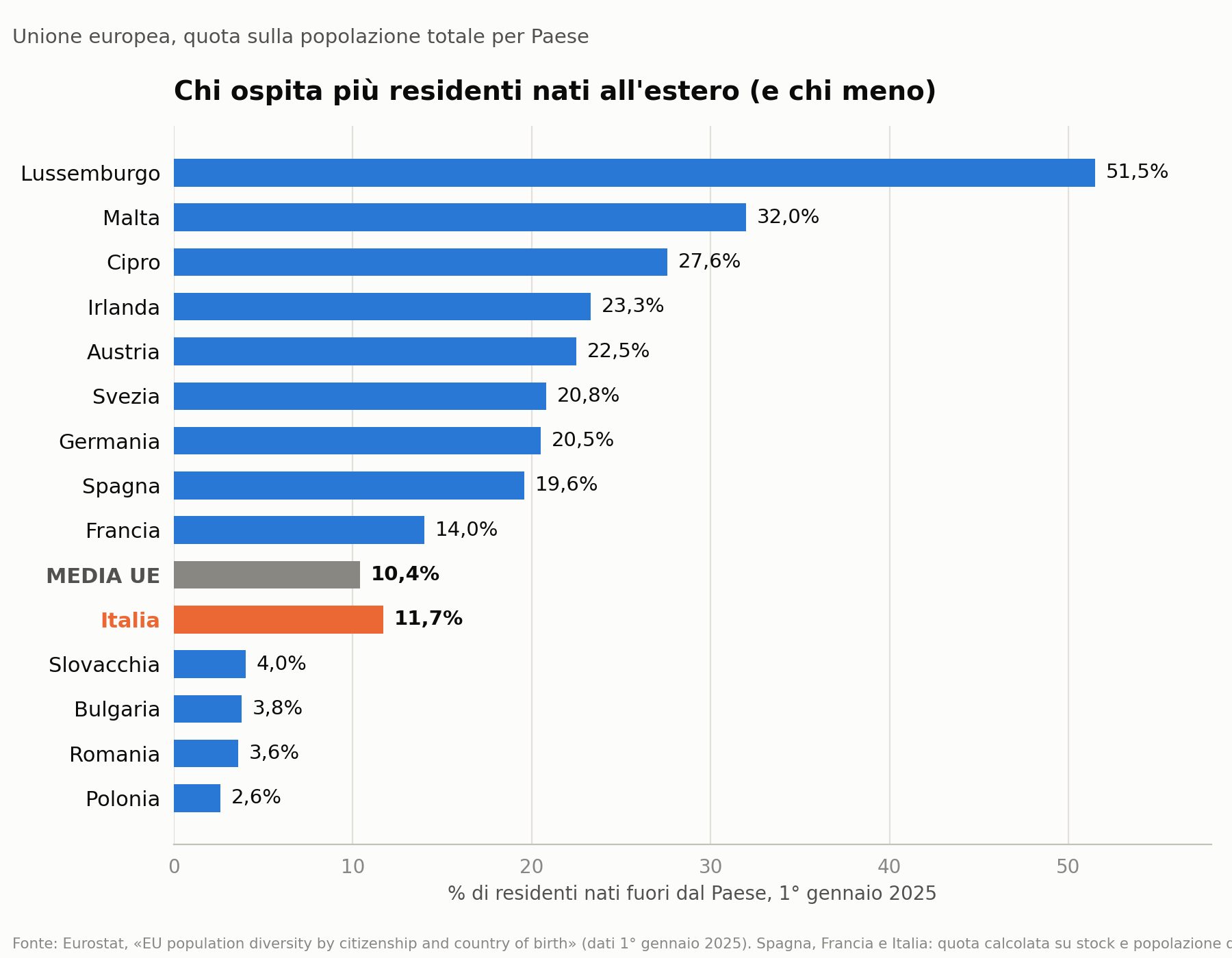
Figure 1 — Share of population born abroad in EU countries, Eurostat 2025 data: Italy sits roughly in the middle of the ranking. Source: Eurostat.
To grasp the order of magnitude involved, it is worth starting with the most recent Eurostat data. On 1 January 2025, 46.7 million people born outside the EU’s borders (10.4% of the population) lived in the European Union, along with 30.6 million citizens of non-EU countries (6.8% of the population, up 1.6 million on the previous year). On top of these there are 14.1 million citizens of another EU member state living elsewhere in the Union, exercising freedom of movement.
The distribution across EU countries is, predictably, highly uneven. In absolute terms the concentration is very strong: Germany (12.4 million non-national citizens), Spain (6.9 million), France (6.5 million) and Italy (5.4 million) together host 69.7% of all non-national citizens in the Union, despite accounting for only 57.8% of the EU’s population. In relative terms, the highest shares are found in Luxembourg (47.0% non-nationals of the total), Malta (29.4%) and Cyprus (24.8%); the lowest in Poland and Slovakia (1.2%), Romania (1.6%), Bulgaria (2.3%) and Hungary (2.7%). The three largest non-EU nationalities in the Union are, in order, Ukrainian, Turkish and Moroccan.
In Italy, according to Istat, resident foreign citizens numbered about 5.3–5.4 million as of 1 January 2024 (9% of the population). The largest group is Romanians, who are EU citizens, with more than 1.073 million residents: on their own, they are not “remigrable” under identitarian logic, which by definition applies only to non-EU citizens. Looking specifically at non-EU citizens alone, Istat data processed by the Fondazione ISMU show that as of 31 December 2024, 3,800,000 non-EU citizens held a valid residence permit in Italy, of whom more than half (53%) held an EU long-term residence permit — the most stable status available. The largest communities are Ukrainian (392,000), Moroccan (377,000), Albanian (361,000) and Chinese (290,000).
It is no longer hypothetical: an Italian bill already exists
Contrary to what one might assume, in Italy remigration is no longer merely a lexical import from the German debate: since 14 January 2026, an actual popular legislative initiative bill exists, promoted by the committee “Remigrazione e Riconquista” (Remigration and Reconquest), born out of the joint initiative of CasaPound Italia, Rete dei Patrioti, VFS and Brescia ai Bresciani, which is currently collecting the signatures needed to bring it before Parliament.
It is worth reading closely, because its definition is narrower than the one invoked at Potsdam. Article 1 defines it as “the voluntary and assisted return of foreigners legally present on national territory to their countries of origin.” Eligible to join, on a voluntary basis, are non-EU citizens who have held a legal residence permit for at least 12 months, asylum seekers whose applications are still pending who voluntarily withdraw them, and holders of non-renewable temporary permits nearing expiry; excluded are those residing irregularly, those convicted of serious crimes, and those who obtained humanitarian protection irregularly. The text provides for the signing of a “Voluntary Remigration Pact,” financial incentives paid out in multiple instalments, pre-departure training programmes, dedicated charter flights, and post-return monitoring, all overseen by a National Directorate for Remigration to be established within the Ministry of the Interior.
On the financial side, the proposal establishes a Remigration Fund with an initial endowment of 1 billion euros a year, which can be increased up to 2 billion; savings generated, if they exceed a certified threshold of 500 million euros a year, trigger a linked Birth-Rate Fund (up to 1 billion a year, with a birth bonus of up to 3,000 euros per child and up to 10,000 euros for a third child). This amounts to a mechanism that explicitly ties the funding of Italian births to the savings obtained by “sending home” non-EU citizens, which makes the ideological underpinning of the measure clear even where its technical mechanics resemble the assisted voluntary return programmes that already exist at the European level (funded, among others, by the International Organization for Migration).
Precisely because it is framed as voluntary and reserved for those who have not yet acquired Italian citizenship, this proposal would exclude exactly the most controversial group in the Sellner-style identitarian version: naturalized citizens. And this is far from a marginal group. Over the past ten years, more than 1.6 million non-EU citizens have acquired Italian citizenship (around 200,000 a year in recent years), and in 2024 Italy was the second-ranked EU country by number of new citizenships granted. It is precisely in the gap between the 6.9 million foreign-born residents in Italy (Eurostat figure) and the 5.4 million resident foreign citizens (Istat figure) that roughly a million and a half people are hidden — people who would be “remigrable” under Sellner’s reading but are not at all under the narrower reading of the Italian proposal.
The economic consequences, should the scenario widen
Even staying within the more realistic bounds of the Italian proposal — that is, the 3.8 million non-EU citizens legally resident in the country — the economic consequences of their return on a large scale would be far from marginal. According to data from the Fondazione Leone Moressa, Italy’s leading research centre specializing in the economics of immigration, immigrant taxpayers currently pay 12.6 billion euros a year in personal income tax (Irpef) to the Italian treasury, against roughly 8.6 billion euros in remittances sent every year to their countries of origin — a net balance for Italy’s public finances that is anything but negligible. To this must be added the now-structural role of non-EU workers in sectors that Italian demographics alone can no longer cover: home care for the elderly (the so-called “badanti,” overwhelmingly foreign), agriculture, construction, logistics. In a country ageing rapidly, the contribution of a foreign population that is on average younger than the national average is not an ideological detail: it is one of the variables currently keeping the pension system in balance.
The boomerang of reciprocity
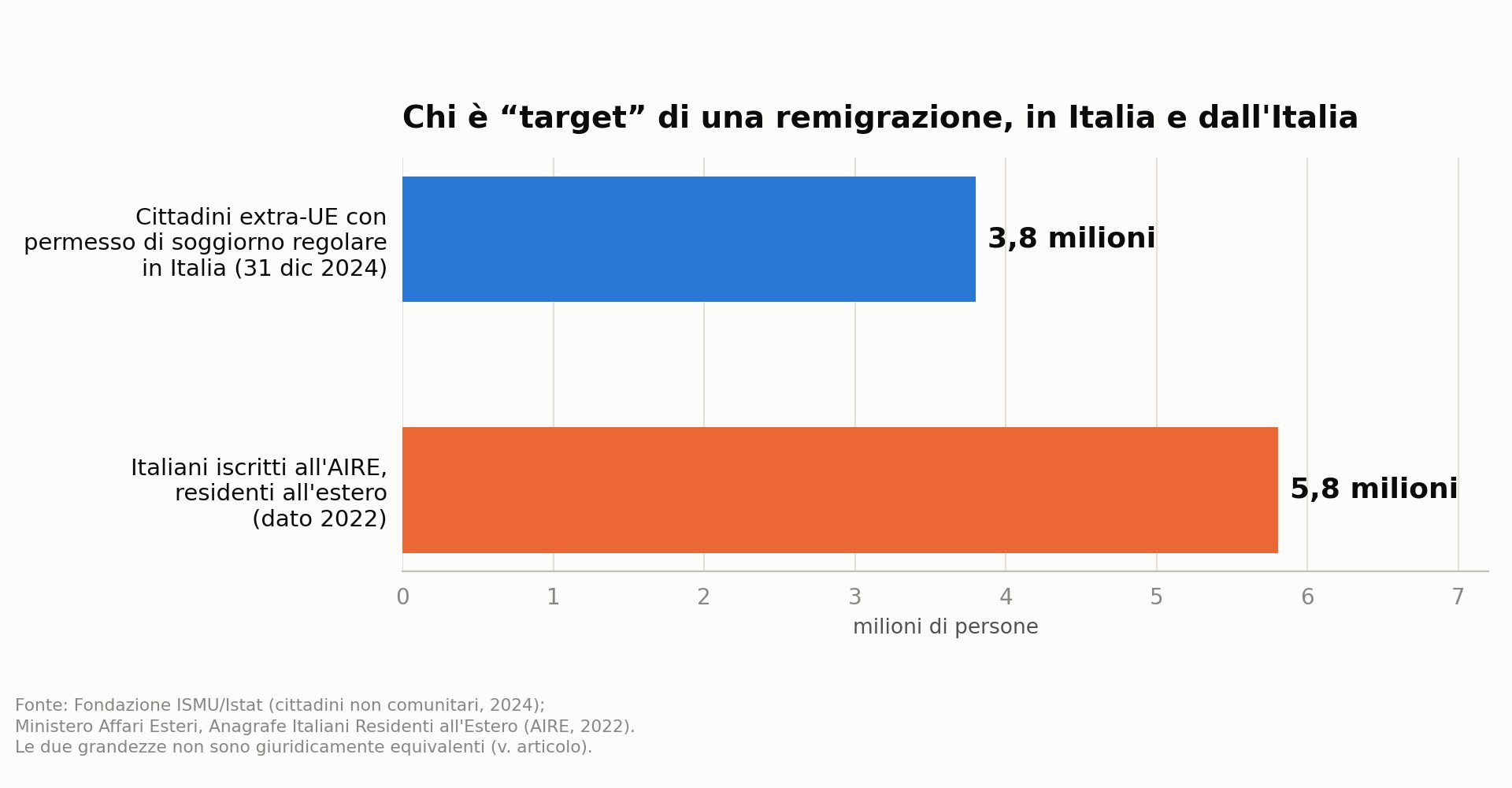
Figure 2 — The two populations compared: the 3.8 million non-EU citizens legally resident in Italy and the 5.8 million Italians registered with AIRE, resident abroad. Source: author’s elaboration on Istat, Fondazione ISMU and Ministry of Foreign Affairs data.
And here we arrive at the most interesting point, the one really worth starting from: what would happen if the same principle were applied, with reciprocity, to Italian citizens who live outside the national borders?
A technical clarification is needed straight away, otherwise the comparison risks being flawed. Italians resident in another EU member state are not, in legal terms, comparable to non-EU citizens in Italy: they are European citizens exercising a right of free movement enshrined in the Treaties, and no government has ever proposed (nor could it, without dismantling the Union’s entire legal architecture) applying “remigration” to them. Legally grounded reciprocity would concern, if anything, Italians resident in non-EU countries: Switzerland, the United Kingdom after Brexit, the United States, Argentina, Australia, Canada.
But there is also a second way of using reciprocity, more as a thought experiment than as a legal proposal, and this is where the Eurostat data offer the best surprise: among all European nationalities, Romanians, Poles and Italians are the three largest communities of EU-country citizens living in another member state of the Union. Italy — the country debating whether to send its non-EU citizens home — is itself, in other words, one of the three leading “exporting nationalities” of mobile citizens within the Union, on a par with Romania, the country most often cited by the identitarian right as a symbol of what it considers excessive intra-EU immigration.
And if we widen the view to the whole world, the numbers remain far from negligible: according to the Ministry of Foreign Affairs, Italians registered with the Registry of Italians Resident Abroad (AIRE) numbered 5,806,068 in 2022, steadily rising from 4.6 million in 2015 (and the European Commission notes that 2024 saw an exceptionally high number of new registrations). The historically largest communities are found in Argentina, Germany and Switzerland, but from 2008 onward the phenomenon changed in nature: those emigrating are no longer predominantly families from the South seeking manual labour, but above all young graduates (including from Lombardy and Emilia-Romagna, as well as from the South) heading to Germany, the United Kingdom, France, Switzerland, Canada and Australia — the phenomenon known in Italy, not by chance, as “brain drain.” Meanwhile, the population of Italian citizens resident in Italy continues to shrink: it stood at 53,383,000 on 1 January 2026, down 189,000 from the previous year.
And this is where the reciprocity argument turns against those who make it. Non-EU immigration into Italy consists largely of workers employed in low-skilled roles, often in sectors that struggle to find willing Italian labour. Recent Italian emigration is, by contrast, largely an emigration of qualified human capital: engineers, doctors, researchers, specialized technicians whom foreign economies welcome gladly, and whom Italy should instead be worried about retaining. If a principle of remigration were applied with genuine reciprocity, the country that would come out worst would not be Germany or Switzerland — which would in any case lose skilled Italian labour that is not easy to replace quickly — but Italy itself, forced to reabsorb hundreds of thousands of its own citizens without having in the meantime resolved any of the structural problems, low wages and a scarcity of skilled positions chief among them, that had driven them to leave.
A balance sheet that does not add up
Holding together these different dimensions — the contribution that Italy currently receives from its 3.8 million legally resident non-EU citizens, the fact that a bill to “send them home” already exists and is presented as a programme of funded voluntary returns, and the cost Italy itself would bear if an analogous principle were applied to its nearly six million emigrants — is perhaps the most useful way to talk about remigration without remaining in the realm of slogans. This is not a moral objection, even though there would be plenty of those to make: it is simply the fact that the numbers, when actually examined, tell a story that is more complicated, and more uncomfortable for those who propose it, than the term itself suggests.